Showing posts with label photography. Show all posts

Monday, 31 October 2011

Annual Blog Post

Well, it's been a year and 15 days (probably 16 by the time I finish writing) since my last blog post. It's not like anybody ever reads it anyway I don't think - most of the feedback seems to be from spambots posting nice comments about where I can source some cut-price viagra.

So, to catch up, this time last year I would've been in the early stages of second year. Second year was a bit crap for various reasons, and I finished up feeling a bit dissatisfied with where I'd ended up, artistically at least. By the end of it, I was really glad to be getting out of GSA for a while, since I'd be going on exchange to the University of New Mexico in the US. I did my usual summer stint at the bike shop, and by mid-August, I found myself in Albuquerque.

Albuquerque is quite a lot warmer than Scotland, though you probably didn't need me to tell you that, right? I got some mental sunburn, especially cycling around trying to find flats spread all across a very expansive city. Eventually, after dodging a few real dumps, I found myself (concidentally) in exactly the same flat that Theresa and Chris from Glasgow had stayed in the year before. The nearest Ikea is all the way up in Denver, so Walmart had to provide the furniture.

The only thing that was kinda worrying me was my class schedule. I'd been advised to take 200-level courses, roughly equivalent to second year at uni. The problem was that there were only two 200-level photography courses, and I hadn't been able to get on early and register for them due to a computer system error, so they were full by the time I got there. Luckily, I managed to beg a spare place on one of them, so I ended up with a timetable consisting of Digital Imaging Techniques, Intro to Printmaking, Modern Art History and History of Photography.

While there are many things I find confusing, bewildering or just plain annoying about the way the American educational system works, perhaps the biggest and most noticeable difference has been that of the workload compared to that of GSA. I find myself with a very frustrating mix - there's a lot more work to do, in terms of volume, but very little of it is particularly challenging.

Admittedly, my printmaking class is pretty challenging, but I put this down to the fact that I've never really had to create decent artworks without the aid of a camera before, and having to rely purely on my clumsy hands leaves me somewhat limited.

My big worry is that I'm going to be somewhat left behind as a photographer when I return to Glasgow. I've been hearing all about the really interesting stuff that people back home have been up to, and all I've been doing is photoshopping daft pictures of penguins looking at abandoned shopping trolleys (I scored a perfect 100% for that assignment by the way).

What I have been doing is trying to keep my own little personal side project on the go, shooting a LOT of Polaroid snapshots as I go along. I guess there's no deeper meaning to these, but they are really good fun (when my camera isn't deciding to spontaneously destroy itself) and definitely go a long way towards trying to keep me at least reasonably sane.

Wednesday, 6 October 2010

Getting There

Now into my third week of term two, and things aren't quite where I'd like them to be... that's not to say it's all bad though. The good news is, I can now develop and print in colour, which makes me happy - it's something I've wanted to learn for a long time. Admittedly, most of the tricky parts are taken care of by machines, but I still enjoy making the prints in the darkroom.

I'm not too keen on the colour paper though - I'm using Fuji Crystal Archive, as it's apparently the most easy to get regular supplies of. It has that weird plastic feel much like cheap inkjet and resin-coated black and white papers, definitely not too keen. The much nicer feel of fibre-based paper is just one of the many things drawing me back to black and white.

I'm still no further with choosing an aim for this term's work. It seems that with everything I read, and every artist's work that I look at, I just seem to be adding layer upon layer of confusing directions that I'd like to take my work in. I guess all I really need to do now is sit down and try and consolidate these messy thoughts into some kind of coherent form that I can make a body of work based on.

Researching can be dangerous in some ways. I had an idea for some work based on the telephone network equipment that I used to work with on a daily basis. The equipment comes in many shapes, sizes, colours, and degrees of flashy LED illumination, and there's definitely some interesting stuff to be found in telephone exchanges, not to mention their great significance as great unrecognised hubs of social interaction. I'd pre-visualised some of the images I had in mind - what I had wanted to feature in the pictures, and how I wanted them to look. With this idea in mind, you can only imagine how it felt when I discovered Lewis Baltz had made a set of almost perfectly identical images in the early 1990s... Damn!

I have to wonder how things might've turned out had I not discovered this Baltz body of work. I wonder about whether I could've confidently forged ahead unknowing, and produced work I was genuinely happy with; whether I could've exhibited the work without anybody ever noticing, or whether I'd even get the chance to hear viewers making the snide "he's just ripping off Baltz" comments. Mysteries indeed. Either way, I'm not sure I can feel confident in going ahead and making that set of images knowing there's something so close to my intentions already out there.

As it stands, I've cobbled together a couple of things that I might look into. One that's standing forward in my mind is the idea of the Scottish colour palette. I'd been looking at Joel Meyerowitz's Cape Light series, along with the work of Stephen Shore (among others) and really getting this feel for a very American type of light. I'd noticed this in New Zealand too - that the light had a very different quality about it. Scottish light is something special though, never does light get so incredibly flat and featureless. It has an incredible ability to absolutely suck the life and colour out of any given scene.

At first, this was of great frustration for me as a photographer in my early days. I was a big fan of high-saturation film, especially Kodak 160VC, and it made for some really crappy looking pictures when the light was flat. Trying to push out tons of contrast on overcast days just led to some really disappointing images. I almost wouldn't bother leaving the house some days if the skies were cloudy. On a recent trip up through the north-west of Scotland, I started beginning to appreciate this flat light as something very fundamental to the Scottish way of life.

Being Scottish is something I quite often have problems with. On one hand, I do find a lot of the landscapes, places and people very inspiring; but on the other hand, there's nothing that pisses me off quite like stupid nationalism (Scottish or otherwise), and the last thing I would want to do would be to take postcard shots of beautiful mountains and for anyone to get this idea that I was a full-blown proud Scot, because I'm most certainly not that.

Monday, 20 September 2010

The Beginning of What's About to Happen

Moustache man

Today was the first day back at art school again after working all summer. Was good to see all the people I hadn't been able to see over the summer, although in truth it felt like we'd hardly been away any time at all.

The big thing this term is colour photography. I'm kinda excited about the prospect of learning about colour developing and printing, although not so sure how enthusiastic I am about working in colour. I seem to have developed a bit of an attachment to black and white, something about it just seems right to me. However, it's always pretty good to be able to push my personal boundaries, so I guess I'll just need to see how it all looks once I get the ball rolling.

My biggest worry was a potential shortage of ideas coming into the year - I had grand plans of using my summer in order to investigate and begin initial developments into ideas for photographic projects; although with the joys of working full time, this didn't really happen. Thankfully, a lecture from our year tutor gave us quite a few useful starting points to have a look at. It definitely makes generating ideas a lot easier when you've got some good people to rip off - lots of further digging into a few names needed I think. I'm certainly not reluctant to say that I thought quite a lot of the images were total crap as well, but such are the joys of being an opinionated bastard sometimes.

I guess my next task is more reading. I have Charlotte Cotton's The Photograph as Contemporary Art on loan, and Susan Sontag's On Photography waiting on my bookshelf. Think I'll need to give Chromophobia by David Batchelor another run over too - it made for quite interesting reading, but a wee refresher with more of a look specifically at where my project's aims are would be pretty handy I think.

Let's see what happens next.

Thursday, 15 April 2010

Polaroid DS-34 GelCam

Polaroid DS-34 GelCam

This is the latest weird and wonderful addition to my camera collection - a Polaroid/Fotodyne DS-34 GelCam, apparently used to record Gel Electrophoresis.

It's a pretty interesting camera. It takes regular Polaroid/Fuji packfilm (FP-100, FP-3000 etc.). The rollers and stuff were pretty disgusting when I opened it up, but it was nothing a quick wash down couldn't sort out. It has a Tominon 105mm f/4.5 lens on the front with a Copal shutter. Shutter speeds range from 1/125 to 1sec and bulb, and apertures from f/4.5 to f/32. The shutter is actuated by a cable release - the pistol-grip handle on the bottom of the camera has its own cable release built in, but the handle can be removed for mounting the camera to a tripod, and the cable release replaced with a regular bog-standard model. There's also a PC flash terminal with x-sync, which works.

Because it's a rigid body with a large format style leaf shutter, it's basically a fixed macro camera. Focus distance is somewhere in the region of about 30cm. Because it was designed to be mounted to scientific equipment using a fixed lens hood type thing, there's no way of telling whether or not you're in focus. I work out the correct camera-to-subject distance by using a shoelace that I calibrated to the correct distance and marked with a pen.

There's no viewfinder either. You may notice the three bits of gaffer tape on the top - I stuck them on to roughly indicate the angle of view. Not ideal, but it'll do for now I suppose!

The best part of it all? It only cost me about £12 :-)

I'll write a more full and detailed post on the camera once I've got to know my way around it a bit better.

Friday, 2 April 2010

Fandan

Earl

You may have noticed it's been quite a while since I last posted a blog entry. This is very bad of me, and a bad habit I seem to get into from time to time - just plain forgetting to keep things up to date.

Since my last post in November, I've undertaken a pretty big step with my photography. I'm now studying towards a BA in Fine Art Photography at Glasgow School of Art, and it's great. I'm now about three quarters of the way through the first year of the course, and actually amazed how time has flown by, seems like no time at all since I first appeared there.

Before I arrived at the Art School, I wasn't really sure what the hell to expect. I'd not managed to go on any of the open days because I'd been in New Zealand, and my only experience of the school had been a few visits to the degree shows. My last experience of any formal art education had been in my standard grade art class at high school, back in 2001 or thereabouts, and even at that I wasn't very great.

Anyway, in spite of the nerves beforehand, I've been managing to cope pretty well so far I reckon. The stuff along the lines of theory and history were what I was most worried about, but thankfully the essays have been pretty short for that, and I don't mind presentations too much.

The general working environment has been quite interesting to get used to as well. Having come from a very task-based environment as an engineer, it's been a bit weird getting used to the more free-flowing way of working in a studio with a pretty open timetable. I have to say, I definitely enjoy the freedom, but it does sometimes make it pretty tricky trying to force yourself to get work done when things are quiet.

The people are good, and a lot easier to get on with than I had expected. Admittedly, there are very few (if any) people who share my taste for a spot of Slayer, but it's nice to be surrounded by lots of people with lots of interesting ideas and different viewpoints. I don't see myself putting on the skinny jeans and buying dubstep records just yet, but being one of those art school fandans isn't quite so bad after all...

Wednesday, 9 September 2009

Quick-N-Dirty Film Removal

Previously, whenever I've been developing my own 35mm film, I've always used a manual-rewind camera, and deliberately made sure not to wind all the film back into the cannister. This meant it was nice and easy to get the film from the cannister onto the dev tank spiral, as there was no faffing about trying to get the film out of the cannister. You just made sure there was always a wee bit hanging out.

Now though, I've been using my new and super-cheap Nikon F75, which has an automatic film rewind on it. This is great, because it saves you having to wind a daft wee crank for ages. However, it has the downside that it sucks the film all the way back into the cannister. I've read about various techniques for getting the film back out, but those involved special film extractor tools (I don't have one), or hacking the cannister to pieces (not so easy in a dark bag). I decided to try and find some more "quick-and-dirty" ways of getting the film out, and I stumbled across This Page via google.

The technique, which was brilliantly effective, involved using a strip of dymo tape, sticking it inside the cannister, and using the sticky side to pick up the film and pull it out. For those of you unaware, Dymo tape is the old-skool plastic tape used for embossing letters onto, used before the days of laser label printers and stuff (See example).

Here are the simple stages required:

  1. Take a strip of dymo tape, approximately 10cm (4 inches) long.
  2. Peel backing plastic off, exposing sticky adhesive.
  3. Push piece of tape into the film cannister through the opening slot, with the sticky side facing in towards the central spindle.
  4. Once the tape is in about 7cm (3 inches), you'll start to feel it jam. Pull the tape in a little further by winding the film spindle.
  5. Firmly (but not too hard), pull on the tape that's left outside the cannister. This should pull the end of the roll out through the opening slot.

For those of you worried, the adhesive on the dymo tape shouldn't damage the film at all. For starters, the adhesive only touches on the backing film, not on the emulsion side, so the emulsion will not be damaged. The tape only touches on the first 10cm (4 inches) of the roll anyway, which will usually be exposed to sunlight when loading, so will be no use anyway.

Works a treat!

Thursday, 13 August 2009

Holy Mountain

Holy Mountain

Last night, I had the pleasure of shooting a band called Holy Mountain, playing live at the Captain's Rest, Glasgow. For me, Holy Mountain are one of those bands that make Glasgow music ace. It's kinda cool but kinda depressing knowing that there are some excellent bands in Glasgow that totally rule, but are never ever going to be on Top of the Pops. Holy Mountain, Black Sun and Take A Worm For A Walk Week are all prime examples of top notch bands living out on the fringes.

So anyway, the Captain's Rest is a bit of a mixed-bag venue for me. I kinda like the space and all, but the lighting's pretty terrible, and it can get very very hot downstairs. Lighting was bad enough for the first two bands who played on stage, but Holy Mountain did their usual thing of playing out on the floor, so there was pretty much no light whatsoever - meaning there was no choice but to go to the wide-angle lens and flashgun and try a little bit of slow-sync.

Full Gallery is available on my website.

Thursday, 23 July 2009

Here Come The Waterworks

Tent Rescue

I'm just back from possibly the biggest failure of a holiday ever! My friend Sara and I decided it'd be good fun to get away from things for a couple of days and head to the Isle of Arran, just off the west coast of Scotland. Arran's great, because it's so easy to reach from Glasgow by public transport - a train from Glasgow Central station to Ardrossan Harbour (about 40mins), then jump straight on the MV Caledonian Isles, the CalMac Ferry between Ardrossan and Brodick, the main town on the island.

Being poor and all, we decided it'd be a good plan to go camping. I had a tent and knew of a great wee camp spot at a place called Glen Rosa, about a mile's walk to the north of Brodick. I'd been to Glen Rosa the two summers previous to this trip, and it had proven to be a perfect base for getting around the island, in a quiet-yet-convenient-enough setting.

After arriving, we got our tent pitched up in a fairly nice spot by the Rosa Burn, the river running adjacent to the campsite. Unfortunately, the weather wasn't great, so we decided just to sit in the tent and wait until the weather passed over. Unfortunately though, the weather didn't pass over for a while, and in fact, the heavy rain had caused the river to swell up. Luckily, another group of campers had been paying close attention to the river levels and had alerted us just in time to pack up all of our things and shift the tent to higher ground before the deluge came forth and swept us down to the Firth of Clyde!

Moving House

We managed to get our gear to safety, and I managed to grab a few snaps of the last remaining tents getting dragged through the rising floods. Unfortunately however, in the rush to get everything moved, most of what we were carrying ended up getting pretty well soaked. While I had made what I thought to be a safe shout relying on one pair of waterproof hiking boots to last me the trip, I hadn't bargained on having to wade through a couple of feet of flood water, so I'd have had to traipse around in soggy boots for the remainder of the time.

We stayed the night at the campsite, but decided on hearing rain on the tent the next morning, that we'd just abandon the trip and head home early. Some bacon rolls at the Bilslands cafe soon lifted our spirits though, and we even got a top notch celebrity-spot in the form of former Deacon Blue drummer turned TV presenter Dougie Vipond. Obviously, Bilslands Cafe is the place to be seen for top celebrities when holidaying in Brodick. Of course, true to form, the minute we got on the boat, the skies miraculously cleared, making the rest of my journey home all nice and sunny. Damn.

Friday, 10 July 2009

Riding The Rails

All Aboard

Just got linked to a great set of images from Photographer Ben Speck on Getty Images, looking at the hobo subculture in the USA, specifically those hitching rides on freight trains. Quite an interesting read, as well as a fantastic selection of photographs.

The whole idea of hopping on and off trains has always interested me to a large degree, ever since first reading Kerouac's On The Road. Seeing the movie Into The Wild just helped hammer this fascination home, although definitely didn't show it as the easy-going free ride that it would be all to easy to think of it as.

Of course, my own rail experiences in the US were limited to regular Amtrak passenger routes, but even these were a good deal more romantic than the usual Scotrail experience!

Thursday, 9 July 2009

Waiting For Film

Photo by Sara MacGregor

Waiting for film has to be one of the most frustrating things about photography for me. Don't get me wrong, I love getting the films back from processing, but it's that anxious spell in between that gets to me!

At present, waiting is what I'm doing a lot of. I've shot about twelve rolls on my Hasselblad since returning from Hong Kong, and now I just need to get around to processing them so that I can see if I'm doing things right or not.

I'm living in Fife at the moment. That basically means I don't have a lab near me that does medium format film, which kinda stinks. Edinburgh's the nearest city that would have the facilities, but my biggest problem is that I don't know or trust any labs there to handle my colour processing. Thankfully though, I do know some labs through in Glasgow who do medium format processing, and even though I live about 70 miles away, I've opted to use Glasgow for my films. I use a wee place called Snappy Snaps on Byres Road, in the West End of the city. It sounds a wee bit like a cheesy holiday-snaps kinda shop, but their range of services is actually pretty great, even doing traditional black and white processing. Unfortunately their staff are a bit crap and unfriendly, but for convenience, I guess you have to put up with these sort of things.

There are (to my knowledge) only two other labs who do medium format film in Glasgow - Loxley Colour at Port Dundas and B&S Imaging in Govan. Loxley do a premium service with the prices to match, and are just a wee bit too out of the way to quickly drop films off to. B&S are more aimed at large-scale commercial operations, but their services are almost on a par of those of Loxley's, but at much more reasonable prices. Unfortunately however, B&S is really out of the way, being out in an industrial estate in Govan.

Labs though, are only necessary for colour processing, since I have all of the kit necessary to process black and white films here at home. It's been a good while since I've done any processing, but I'm looking forward to getting started again. I've decided to change films and developers since last time, to see if I can hopefully get some better results. I had previously been shooting almost exclusively on Ilford HP5 and processing with Ilfotec HC, but I'd found HP5 to be a bit wishy-washy and lacking the real punch I like from my images. In the last year of shooting, I've developed a real love for Kodak TMax 100 & 400 films, so I've fired through a load of TMax 400 over the past couple of weeks.

I've also decided to go with Kodak TMax Developer too - mostly because of how much easier it is to mix than Ilfotec HC. Ilfotec is a 1+31 mix, meaning a bottle can go for a crazy number of tankfuls. TMax on the other hand, is a 1+4 mix, meaning that it's much easier to mix, although won't go quite so far. I've also been looking a lot more into things like how often developer can be re-used, as I'd previously just used the Ilfotec as single-shot, using it once then pouring it away.

All I need to get down to business are a couple more Irn Bru bottles for storing water, and to find what I've done with my neg holder sheets, so that I've actually got somewhere to put the films once I've processed them.

If you've any feedback or hints/tips you'd like to share, please feel free to add comments to this post :-)

Wednesday, 1 July 2009

Shooting Fife

Skyscape

I've just not long returned from a long big extended holiday to New Zealand, stopping in to the USA, Canada and Hong Kong along the way. I took a lot of photos along the way, and had a lot of fun - it was great to not really have to worry so much about day-to-day responsibilities, and just getting to see some amazing places and meet some amazing people. These places and people were a great inspiration for my photography work, and I managed to rack up a lot of frames on the journey

My biggest problem at the moment, is how to motivate myself to get out with the camera and keep taking good photos when I live in a sleepy commuter town with no volcanoes, penguins or stingrays to shoot. Of course, this leads to me wondering if I'm actually capable of taking good photos at all, or whether I was just pretty lucky with the subjects!

Stripped

I guess what I'll just have to do is adapt and try and think where I can get the good shots from. I've been out on a couple of nights shooting around the Hillend Industrial Estate, a once bustling, but now declining industrial estate along the northern edge of the town. I was sad to miss the big drama when travelling people showed up en masse in caravans in the grounds of the OCLI factory where my mum used to work. Apparently they'd been forced out of their previous site at the old Lexmark factory in Rosyth by some violent locals, and chanced upon another site just along the road here in Dalgety Bay.

It's been interesting seeing various buildings and factories falling off one-by-one over time. The old Cemtron factory has just recently become vacant, OCLI is being earmarked for housebuilding, Marconi Simulations has been replaced by an ASDA supermarket, and various others have burnt out or fallen into ruin. In fact, one old industrial building (I can't remember what it used to be) is set to get Dalgety Bay's first full-time photography studio when Nikki Mcleod opens her business in there.

Tonight's plan was to take a stroll up to the Cemtron grounds and have a wee peek in, but a thunderstorm with accompanying rain has just rolled over, so I'll just need to see!

Tuesday, 30 June 2009

Happy Hasselblad

While I was away, I added a delightful new member to my family of cameras. I think his name is Bladley, or Blad for short. To be specific, he's a nice Hasselblad 500C/M, and I was lucky enough to be able to grab a Zeiss Distagon 60mm f/3.5 CF along with him.

Blad

So far, we've been having lots of fun together. I've had a few funny moments trying to figure out the various finer points of the many many mechanisms. I'm great at forgetting the dark slide, and especially good at forgetting to wind films off the end of the roll.

Despite the technical hitches though, I'm absolutely loving the camera. It makes a nice kind "CHUNK" sound when you hit the shutter, and the 60mm lens is absolutely fantastic. Just that perfect focal length, and sharp as hell too. I'll need to try and pick up a new, brighter focussing screen though, as I'm not quite so great at getting things bang on.

To have a look at the results of our relationship so far, check out This Set on Flickr

Thursday, 2 April 2009

From The Deep South

Been too long since my last blog update, huh? Again, I'm just gonna fire down one big mega-update and hopefully catch up on everything!

In Christchurch, I got a bit bored mostly. However, I managed to make myself happy with trips to the awesome camera shop, Photo & Video, who gave me a stupidly good trade-in price for my 24-120mm VR zoom lens. Since I've not really been using the lens much (slow max. apertures and soft soft images), I decided to bin it, initially favouring one of the now-obsolete (WHY NIKON, WHY?) 24-85mm AF-S zooms. In the end though, I opted for the brand-new Nikkor 50mm f/1.4G AF-S. It's been lovely, and the best thing is, you actually no longer really need light to take pictures!

One of the other good things about Christchurch was getting to meet up with Adam, a flickr contact of mine and fellow lover of Nikons and OMs! He was good enough to take me on a trip up the Clarence river, where I managed to catch my first ever fish, a nice big Trout. I ripped the arse out of my shorts and tore my lucky boxers after a failed attempt to negotiate a steep scree slope, but catching the fish made it more than worthwhile.

From Christchurch, I headed back over Arthur's Pass to the West Coast. The weather was beautiful the whole way over, right until about Arthur's Pass itself, at which point, the big clouds rolled in and opened up over everything. Otira Gorge was cool, but I suspect it would've been a lot cooler if I could've actually seen anything through the clouds and heavy heavy rain. Unfortunately the weather didn't really pick up much at all the whole time I was down on the West Coast.

I stayed a night in Hokitika, then headed on to Franz Josef, hoping to take a helicopter trip up to the glacier there. Unfortunately though, the weather was super-suckin' so they weren't flying. And of course, just my luck, the weather cleared up beautifully just on the day I'd decided I wasn't waiting any longer and had decided to hit the road.

I headed on through the Haast Pass, dodging the suicidal tourist snap photographers at the Gates of Haast rapids, and on to Wanaka. Deciding to dodge the armies of Leki-pole-armed Germans in the town of Wanaka, I opted instead to follow a back road around the lake to a nice wee unofficial campsite - sshh, don't tell the DoC!

From Wanaka, I followed the Clutha down through Central Otago, dodging a mini-tornado at Alexandra which flattened some poor person's jeep. Thankfully, the wagon and I made it through unscathed, settling for the night in Ranfurly. I had considered staying the night in St. Bathans, an interesting wee ghost town, and wished I had after finding what might well have been New Zealand's shittiest backpackers hostel in Ranfurly.

Despite Ranfurly not being up to much, my next day was far more successful. I made it down to the east coast at Palmerston, and headed out on a mission to spot some penguins. Although my initial penguin spot was terribly exciting to me, I was advised of a better location a couple of km up the coast at a place called Moeraki. I was able to get within a few feet of the penguins there, and I snapped away like a man possessed.

To be continued...

Friday, 6 March 2009

Antichristchurch

Well, after leaving Wellington, things have been a bit up and down, and are now firmly on a downer in Christchurch. I've been stuck here for about two weeks now, after really only intending to be here for a couple of days. It's flat, and the population seems to be mostly neo-nazi dickheads and foreign pensioners. Anyways, enough of that... time for a quick update on progress so far.

Started in Picton, headed into the Marlborough Sounds. Spent my first night in a place called Hopewell in possibly the best backpacker hostel ever. I rented a kayak for $10 and paddled around, and it was very much fun. I even took the F65 out with me and took some photos while I was out there. Next night involved some shady mountainous dirt roads on the way over to a place called Titirangi. The weather was crap when I arrived, and my passport fell out of the van on the way over (long and silly story), but the next morning, all was clear and sunny and I even managed a swim in the sea, something I really don't do often.

Next was Elaine Bay, a bit further over to the western side of the sounds. Cool spot with a wee pier and stingrays floating about in the water, and I got chatting to Simon, a Canadian fellow van traveller. All was great, except my legs got absolutely annihilated by sandflies. Carried on to the relative civilisation of Nelson, met up with Simon for a beer and only partially successful attempts to chat up some girls from the Kiwi Experience bus.

Headed up to Motueka, did Karaoke for only the third time in my life, waltzed with an old Maori alcoholic woman, and hung out in a very Phoenix-nights hotel/local pub. Headed on up through Takaka and its hippies on my way to Cape Farewell. Headed back down into Nelson, then back over to the West Coast. Was blown away by the delights of Westport, failed to find penguins on a beach in the middle of nowhere, and eventually ended up staying in Greymouth.

Drove over the Lewis Pass, which would've been pretty amazing if I could've seen any of it (the clouds were low, and it was raining). And then Christchurch. As I said earlier, flat, bland, and full of weirdoes.

Next move is a fishing trip up into the hills, back to Christchurch once more to sleep it off, then I'm gonna head over Arthur's Pass to the West Coast again, and hope the weather's not too crappy when I get there!

Saturday, 2 August 2008

Jobless Über Alles!

As you may or may not be aware, I used to work for BT, then decided to take a redundancy package and go away to New Zealand for a while with the proceeds. I thought the limbo period between quitting and actually getting on the plane would be incredibly tedious and boring, but in fact, I can't remember having quite so much fun for a long time!

At first there was a lot of photography getting done, which was very enjoyable. Meeting up with the similarly jobless Sara and spending whole days just snapping away is excellent fun. She got herself a nice new Nikon D80, and she's been getting some pretty ace results with it so far.

Of course, not having to get up for work in the morning has meant that trips to the pub have been coming thick and fast. On one of these nights, we'd been having a few cans of the almighty Super T at John and Dunc's flat, and decided it'd be a really good idea to go camping the next day. The next day, as promised, we managed to haul our sorry behinds down to Ardrossan and jumped on the Calmac boat to Arran for what turned out to be a pretty ace wee holiday. We spent two nights camped at the fantastic Glen Rosa campsite in my trusty Black's tent, complete with high-tech LED lighting system. Activities participated in included regular walks to the Brodick Co-op for bacon rolls, Crazy Golf, and a bus journey round the island, broken up with a few beers in Blackwaterfoot.

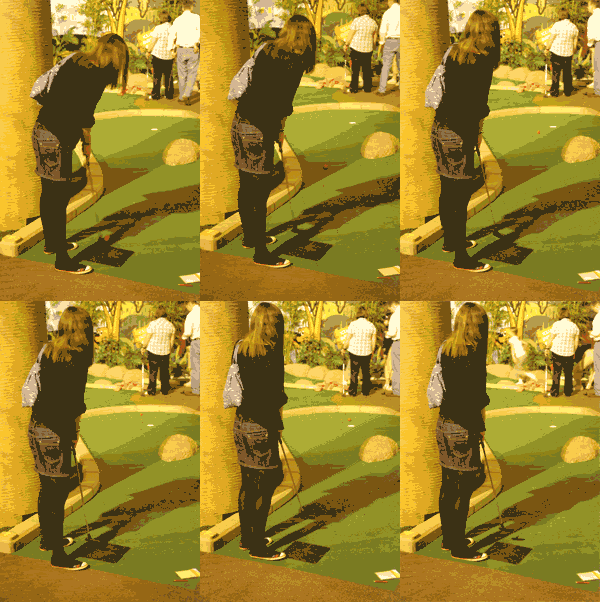
Hole In OneThe Crazy Golf didn't stop there though, as just a couple of days ago, I had the opportunity to play on what is supposedly Europe's largest crazy golf course, out at Xscape at Braehead. The courses maybe didn't quite have some of the craziest features on offer (whit, nae windmills!?!), but with 36 holes to play, we certainly got a fair bit of playing done. Of course, fresh from my experience on the infinitely more difficult Brodick course, I gave Sara a bit of a thrashing, coming in at one under and three under in the two 18-hole games we played.

Thursday, 1 May 2008

Scanner Has Arrived

Epson 4490 Scanner

I'm very very happy now, because yesterday, I went and picked up my new Epson Perfection 4490 Scanner, which means all those little silly images that I uploaded to flickr as poor-quality contact sheets, can now be seen in their full glory. It makes me happy!

I scanned my first roll of 35mm last night, which was kinda nice. Thankfully it was one of the rolls I'd made a bit better a job of in the developing stages, so the scans all came out pretty nicely. I think the plan for tonight is to try and get another roll scanned, and just keep gradually builing up a nice wee archive. At the moment, I'm only scanning at half the maximum resolution to keep times and file sizes down for scanning everything, but I reckon I'll just crank it to max for anything where I need that wee bit extra quality.

The developing's been going mostly OK so far, I had a wee bit of a worry when I changed developers from Ilfosol to Ilfotec HC - the methods of mixing are a bit different, but thankfully the Ilford data sheet came in very handy. I'm just hoping my Ilfotec "stock" mix keeps OK in its current container. I'll also have to get my backside in gear and develop the backlog that's currently building up of films that I need to process. And to think when I first got my developing gear, I actually rushed out the house and shot off a roll just for the sake of having something to develop!

Next challenge is to see about maybe moving outside my HP5 comfort zone. So far I've decided to shoot nothing but HP5, due to it being very widely available and a lot of people saying it's quite a "forgiving" film to work with. Last night I was shooting a gig, so I decided to pop a roll of Fuji Neopan 1600 through, so we'll see how that turns out. Also very tempted to try experimenting with pushing HP5, although I've heard it's pretty bad at 1600.

I'm sure there'll be plenty of photos on my Flickr Page (www.flickr.com/photos/twentyhertz) coming soon for anyone who cares to read this to see how I'm doing :)

Wednesday, 9 April 2008

DIY SOS!

As much of a fan of Nick Knowles and his team of merry workmen as I am, I'm focusing more on the photographic rather than home improvement side of DIY! Recently, I've been growing ever discontent with the service from photo processing labs - having to spend the best part of £10 every time I finish a roll, just for the lab to give me the wrong prints, not scan all of the pictures, and in the worst case, even completely ruin a set of negatives.
  • (Name and shame corner: Jessops on Sauchiehall Street, Glasgow managed to put a deep scratch through an entire roll of film that effectively rendered it unusable after the first set of prints.)

I decided I'd be a lot better off taking matters into my own hands. Seeing how I love shooting on XP2 monochrome film most of the time anyway, I decided it'd be quite cool fun just to shoot on proper black and white film, and develop it myself.

The grand plan as it stands runs in two stages: firstly, learn to process the black and white film, then scan it into my PC for the full joy of digital working. So far, I'm in the process of working with the film, and hopefully by next pay day, I'll be able to afford a decent scanner. My reasoning for thinking like this was that when I get a film processed, I usually flick through the prints a few times then stash them in a box under my bed, and use the negative scans on supplied CD on my PC for any future printing/publishing to Flickr etc. Rather than get bogged down in the extra hassle involved in making my own prints, I decided a decent film scanner would be the easiest way to go for creating a "finished product" so to speak.

So I took the plunge and invested in a developing tank and some basic chemistry to get me started. I'm currently using the following:

  • Paterson 600ml Developer Tank (2x35mm or 1x120 film)
  • Ilfosol Developer
  • Ilfostop Stop Bath
  • Ilford Rapid Fixer
  • Jessops thermometer

I've been a big fan of stuff shot on Ilford HP5 film, so that's been my main material for practicing with. My choosing Ilford stuff through and through isn't due to some big brand loyalty by the way - it's just a simple case of it being the most commonly available b/w stuff in shops in Glasgow. I'm just sticking with HP5 at the moment, as it's a reasonably decent all-round performer, and sticking with one type of film makes it a lot easier for practicing my developing skills.

My setup at the moment is somewhat primitive - my chemicals are all mixed/stored/poured from 750ml Irn Bru glass bottles, and my darkroom is the bathroom with the light off! My biggest challenge has been trying to keep everything at the required 20degrees C.

The first attempt at processing film was a bit of a disaster - with passable, but not great results. I think I was in too much of a rush and got too shaken up by the whole experience, not to mention shaking my tank up a bit too much in the process! After taking my results and going back on the web, I managed to find some sites telling me exactly what I'd done wrong.

Since this roll, I've processed another three rolls, the following all having been done using 120 film rather than 35mm due to both of my 35mm cameras dying on me. They've all turned out pretty well as far as I can tell. Sadly one of them is mostly ruined due to a shutter failure on my Seagull. The last one I did, I'm not entirely sure what went wrong with it, whether it was overdeveloped or whether it was overexposed - I thought it had all been shot at 1/125 sec, but the motion blur on a lot of the pictures would suggest it had been much slower than this, and my Seagull had been having shutter difficulties that day.

Anyways, that's it so far. Hopefully the other OM-10 I bought from ebay should arrive soon and allow me to keep shooting 35mm stuff, and hopefully next month I'll have a shiny new scanner to allow me to put proper big pictures on Flickr for the world to look at!